Can I Use This During Pregnancy? The Complete Ingredient Safety Guide
Updated
Retinol, salicylic acid, niacinamide, AHAs, peptides…an A-to-Z 'Can I use it?' encyclopedia for every activity you've ever wondered about, with safe alternatives Indian moms can actually buy.
Retinol, salicylic acid, niacinamide, AHAs, peptides…an A-to-Z 'Can I use it?' encyclopedia for every activity you've ever wondered about, with safe alternatives Indian moms can actually buy.
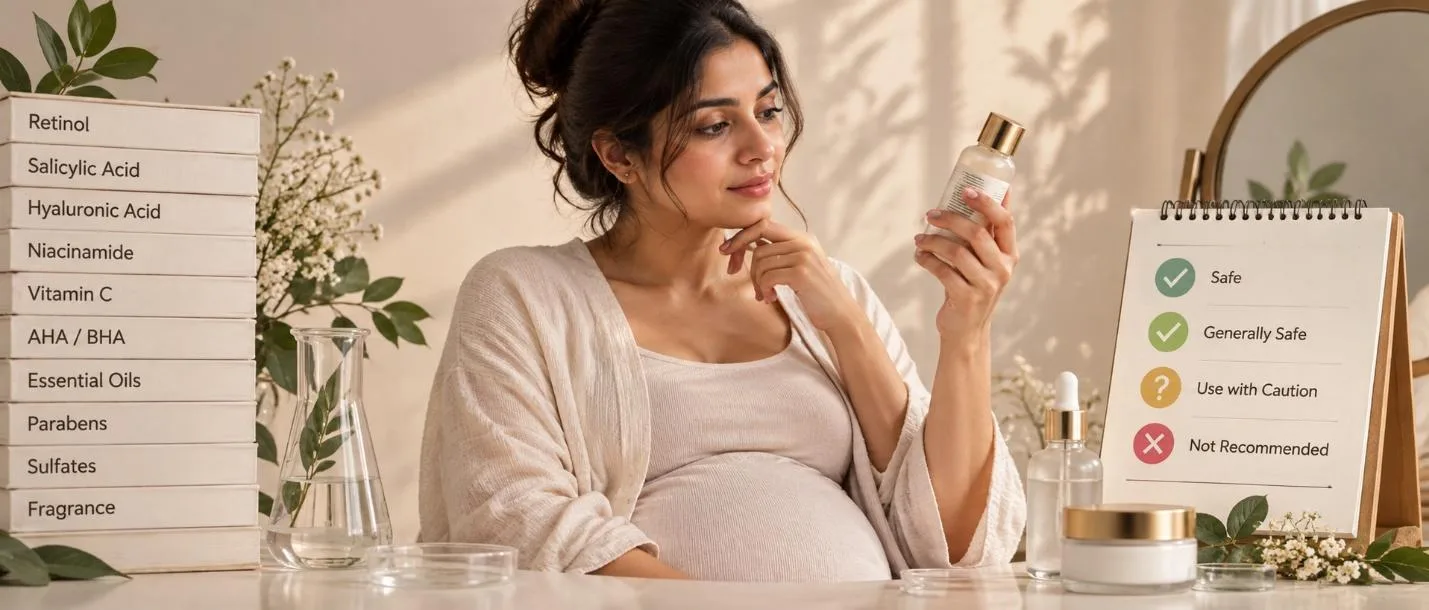
Pregnancy can turn a normal skincare shelf into a list of questions. Can you still use retinol, salicylic acid or Vitamin C?
This pregnancy safe skincare ingredient safety guide is designed to give you a clear answer without making every ingredient sound frightening. Some should be avoided, while others simply need more care with concentration or frequency.
The safest approach is to look at the active ingredient, its strength and how the product is used rather than judging something only by its marketing label.
Your obstetrician or dermatologist should always have the final say, particularly if you use prescription products.
Retinoids: Avoid During Pregnancy
Retinoids are the clearest category to remove during pregnancy, and research clearly states this. This includes prescription tretinoin and tazarotene as well as over-the-counter retinol and adapalene.
Oral isotretinoin is known to cause serious birth defects. Topical exposure is much lower, but dermatology guidance still recommends avoiding retinoids during pregnancy.
Niacinamide and Vitamin C do not work exactly like retinol, but they can support brightness, texture and the skin barrier.
Salicylic Acid: Concentration Matters
Salicylic acid is more nuanced.
Dermatology guidance recommends limiting high-dose products above 2% during pregnancy and discussing their use with a doctor. Limited topical use may be acceptable depending on the formulation and your situation.
For acne, ask your dermatologist about pregnancy-appropriate alternatives rather than using strong peels or layering several acids.
Niacinamide: Commonly Used During Pregnancy
Niacinamide, or Vitamin B3, is one of the easiest pregnancy skincare ingredients to keep in a simple routine.
It supports the skin barrier, helps manage excess oil and can improve the appearance of uneven skin tone.
Luneira Purity Face Wash contains Niacinamide with Panthenol, Aloe Vera and Sodium Hyaluronate, while Eternal Face Serum contains 2.5% Niacinamide with 3% stable Vitamin C.
Vitamin C: A Useful Brightening Step
Topical Vitamin C is commonly used during pregnancy. It can support a brighter-looking complexion, provide antioxidant protection and fit easily into a morning routine underneath sunscreen.
If your skin has become reactive, start slowly.
Hyaluronic Acid: Useful for Hydration
Hyaluronic Acid is another ingredient commonly used during pregnancy. It attracts and holds water at the skin surface, making it useful when your face feels tight or dehydrated.
Apply it to slightly damp skin and follow with moisturiser.
Hydroquinone: Avoid During Pregnancy
Hydroquinone is generally avoided because a relatively large amount can be absorbed through the skin and there is not enough pregnancy safety data to justify its use.
For pigmentation or melasma, focus on sun protection and ask your dermatologist about Niacinamide, Vitamin C or azelaic acid.
Sunscreen: Do Not Skip It
Pregnancy does not mean you should stop wearing sunscreen. Daily protection becomes especially important if you develop melasma.
Use broad-spectrum SPF 30 or higher. Dermatologists often recommend physical sunscreens containing zinc oxide or titanium dioxide during pregnancy, particularly for sensitive skin.
Essential Oils and Fragrance: Be Selective
“Natural” does not automatically mean safe for every stage of pregnancy.
Some essential oils have limited pregnancy data. Fragranced products can also irritate skin that has become more sensitive.
If you are unsure, choose fragrance-free products and discuss concentrated essential oils with your doctor.
Sulfates: Not a Pregnancy Ban
SLS and SLES are not classified as pregnancy-unsafe ingredients. However, they can feel harsh on dry or sensitive skin and scalps.
If pregnancy has made you more sensitive, you may prefer sulfate-free cleansers. Luneira Purity Face Wash and Revive Shampoo + Conditioner are listed by Luneira as sulfate-free.
Let Luneira's Ingredient Scanner Do the Checking
Ingredient lists can contain dozens of unfamiliar names. That makes checking pregnancy skincare ingredients one by one frustrating.
That is why Luneira offers an ingredient scanner. You can scan an ingredient label instead of trying to decode every line yourself and check whether the product fits your pregnancy routine.
Our website also offers a 60-second Safety Check for mothers who are unsure what is right for their stage.
Use this pregnancy safe skincare Ingredient Safety Guide as your starting point, then use the Luneira scanner when a label gets complicated. For prescription treatments or anything you remain unsure about, check with your doctor.
Frequently Asked Questions
What skincare ingredients should I avoid during pregnancy?
Retinoids and hydroquinone are among the ingredients dermatologists recommend avoiding during pregnancy. Prescription skincare should always be reviewed with your doctor.
Can I use salicylic acid while pregnant?
Limited topical use may be acceptable, but high-dose salicylic acid should be used sparingly and discussed with your dermatologist or obstetrician.
Is niacinamide safe during pregnancy?
Niacinamide is commonly used during pregnancy and can support the skin barrier, oil balance and uneven-looking skin tone.
Can I use Vitamin C during pregnancy?
Yes, topical Vitamin C is commonly included in pregnancy routines for antioxidant support and brightness.
Is sunscreen safe during pregnancy?
Yes. Daily broad-spectrum SPF 30 or higher is recommended. Mineral formulas containing zinc oxide or titanium dioxide are a simple option, particularly for sensitive skin.
How can I check whether my current skincare is pregnancy safe?
Read the complete ingredient list, review prescription products with your doctor and use Luneira's ingredient scanner when unfamiliar pregnancy skincare ingredients make a label difficult to understand.